
Reclaiming Climate Tech: Profit, Impact, and Sovereignty
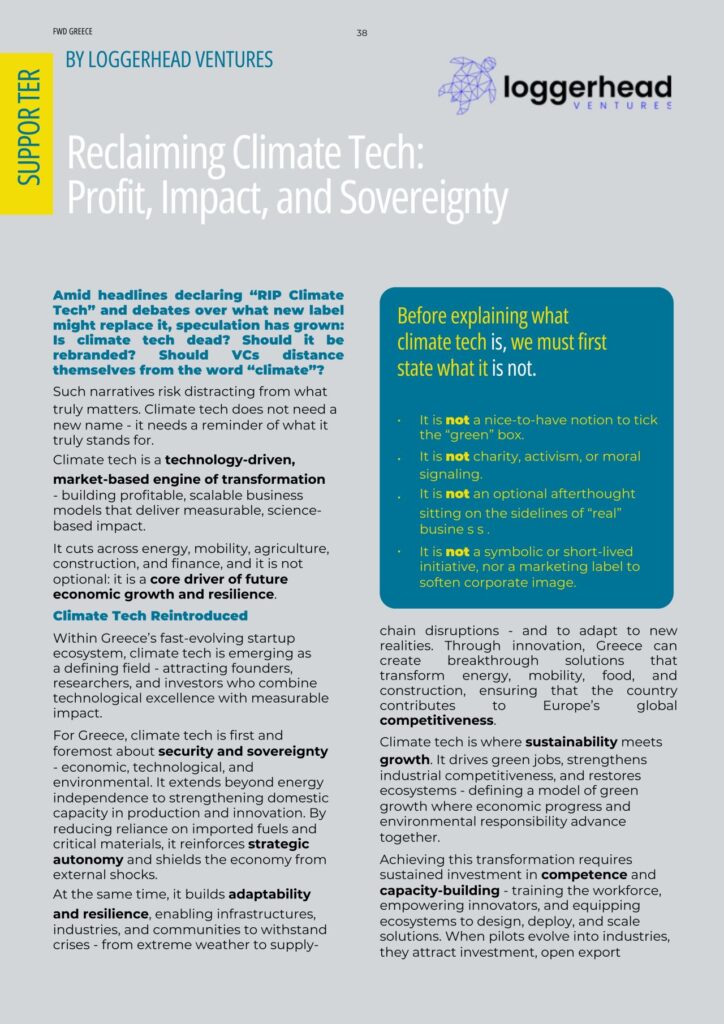
Amid headlines declaring “RIP Climate Tech” and debates over what new label might replace it, speculation has grown: Is climate tech dead? Should it be rebranded? Should VCs distance themselves from the word “climate”?
Such narratives risk distracting from what truly matters. Climate tech does not need a new name — it needs a reminder of what it truly stands for.
Before explaining what climate tech is, we must first state what it is not.
It is not a nice-to-have notion to tick the “green” box.
It is not charity, activism, or moral signaling.
It is not an optional afterthought sitting on the sidelines of “real” business.
It is not a symbolic or short-lived initiative, nor a marketing label to soften corporate image.
Climate tech is a technology-driven, market-based engine of transformation — building profitable, scalable business models that deliver measurable, science-based impact.
It cuts across energy, mobility, agriculture, construction, and finance, and it is not optional: it is a core driver of future economic growth and resilience.
Climate Tech Reintroduced
Within Greece’s fast-evolving startup ecosystem, climate tech is emerging as a defining field — attracting founders, researchers, and investors who combine technological excellence with measurable impact.
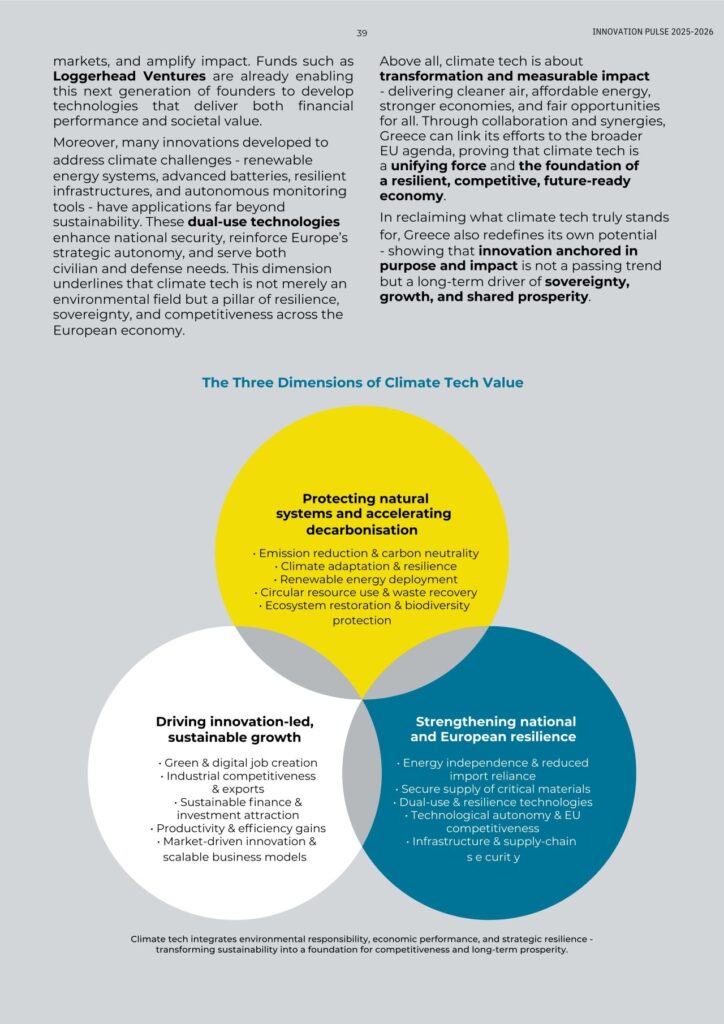
For Greece, climate tech is first and foremost about security and sovereignty — economic, technological, and environmental. It extends beyond energy independence to strengthening domestic capacity in production and innovation. By reducing reliance on imported fuels and critical materials, it reinforces strategic autonomy and shields the economy from external shocks.
At the same time, it builds adaptability and resilience, enabling infrastructures, industries, and communities to withstand crises — from extreme weather to supply-chain disruptions — and to adapt to new realities. Through innovation, Greece can create breakthrough solutions that transform energy, mobility, food, and construction, ensuring that the country contributes to Europe’s global competitiveness.
Climate tech is where sustainability meets growth. It drives green jobs, strengthens industrial competitiveness, and restores ecosystems — defining a model of green growth where economic progress and environmental responsibility advance together.
Achieving this transformation requires sustained investment in competence and capacity-building — training the workforce, empowering innovators, and equipping ecosystems to design, deploy, and scale solutions. When pilots evolve into industries, they attract investment, open export markets, and amplify impact. Funds such as Loggerhead Ventures are already enabling this next generation of founders to develop technologies that deliver both financial performance and societal value.
Moreover, many innovations developed to address climate challenges — renewable energy systems, advanced batteries, resilient infrastructures, and autonomous monitoring tools — have applications far beyond sustainability. These dual-use technologies enhance national security, reinforce Europe’s strategic autonomy, and serve both civilian and defense needs. This dimension underlines that climate tech is not merely an environmental field but a pillar of resilience, sovereignty, and competitiveness across the European economy.
Above all, climate tech is about transformation and measurable impact — delivering cleaner air, affordable energy, stronger economies, and fair opportunities for all. Through collaboration and synergies, Greece can link its efforts to the broader EU agenda, proving that climate tech is a unifying force and the foundation of a resilient, competitive, future-ready economy.
In reclaiming what climate tech truly stands for, Greece also redefines its own potential — showing that innovation anchored in purpose and impact is not a passing trend but a long-term driver of sovereignty, growth, and shared prosperity.
Originally published in the FWD Greece: Innovation Pulse 2025–2026 report by Found.ation, in collaboration with 28DIGITAL and the Hellenic Development Bank of Investments (HDBI).