
Thessaloniki’s Startup Ecosystem: From Funding to Real Growth
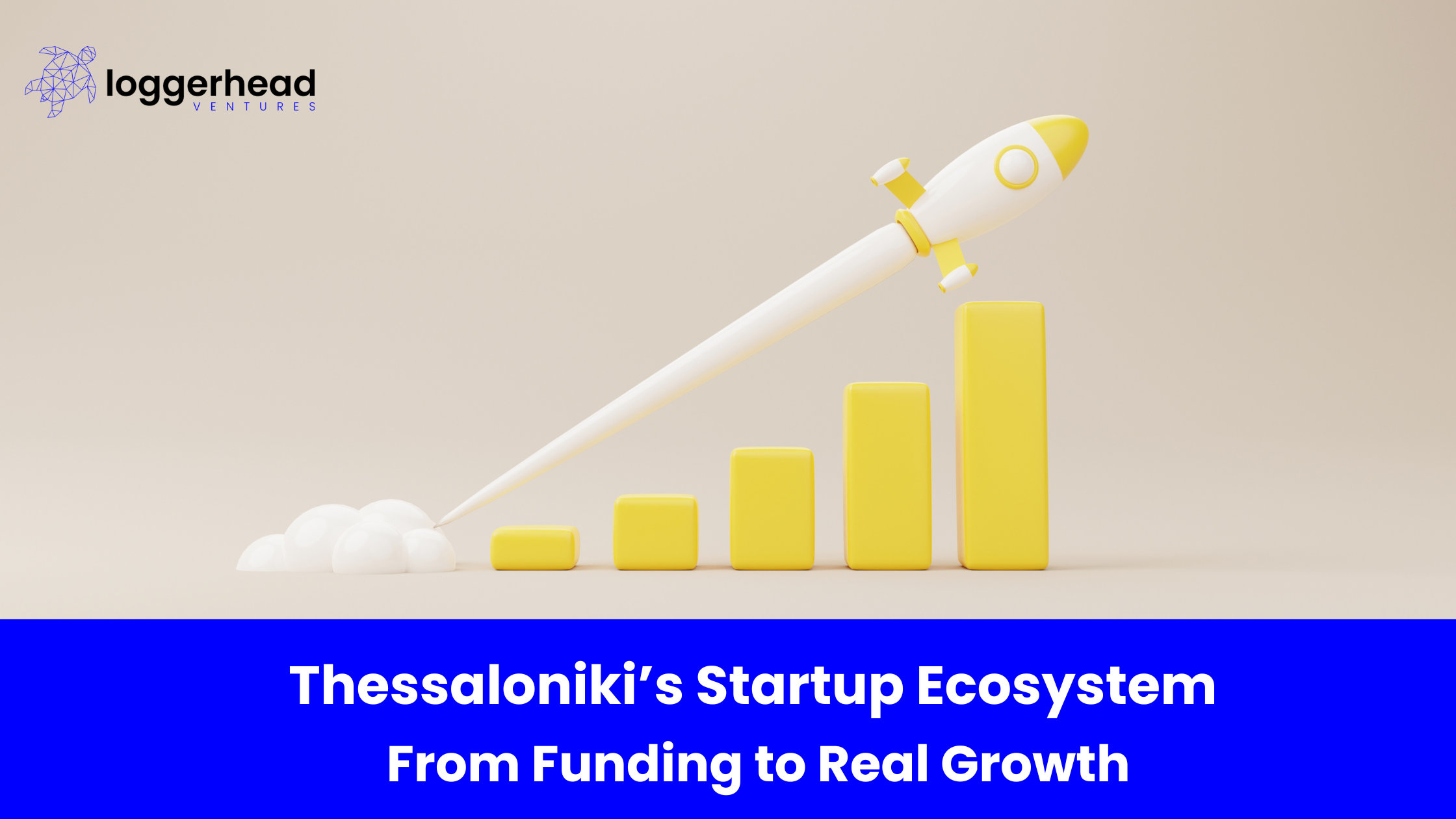
In Thessaloniki’s startup ecosystem—one that has shown clear upward momentum in recent years, with growing activity around teams and innovative ideas—a less visible but critical gap is becoming increasingly evident: the gap between funding and real growth. The challenge is not a lack of capital, but the difficulty of turning early confidence into sustained commercial activity. The transition from funding to growth is neither linear nor guaranteed and, in many cases, it never fully happens.
This is not a uniquely Greek issue, nor a challenge specific to Thessaloniki. Across many emerging ecosystems, access to seed capital has improved faster than access to markets. In practice, many teams manage to finance product development without having yet secured stable enterprise customers or recurring revenues. For those closely observing the market, the pattern is familiar: strong technology, successful pilots, but limited commercial scaling.
One factor that often creates a misleading sense of progress is the role of pilots at the early stages of startups. While pilots are essential tools for validating a solution in real-world conditions, they do not constitute market entry. A successful pilot demonstrates that a product works; it does not prove that an organization is willing to adopt it at scale.
The transition from testing to sustained adoption—where long-term commitment and recurring revenue replace fragmented, one-off agreements—is one of the most difficult hurdles startups face. It is precisely at this point that a second, equally restrictive growth factor emerges: the so-called sales gap.
The sales gap describes the disconnect between a technically sound, validated product and a team’s ability to sell it in a structured, repeatable, and scalable way. Technological excellence alone does not translate into commercial success without a clear sales strategy, strong positioning, and a solid understanding of market dynamics. As a result, products with genuine value often remain locked into isolated partnerships, failing to build a consistent commercial footprint.
This gap becomes even more pronounced when startups attempt to expand internationally—an inevitable path for many. The domestic market is limited, and in many cases, enterprise buyers are simply not sufficient to support meaningful scale. Yet international growth presupposes an established track record, market presence, and proven trust from customers. It requires organizational structures, experience, and access to networks that are often missing. The outcome is products designed for global markets, but without the tools needed to truly compete in them.
None of the above should be seen as isolated missteps or weaknesses of individual teams. The transition from funding to real growth is not solely the responsibility of startups themselves. To a large extent, it reflects the maturity of the broader ecosystem in which they operate. When funding outpaces access to markets, the gap cannot be closed simply by injecting more capital.
At this point, the role of investors and ecosystem actors becomes decisive. Beyond financing, active involvement in commercial strategy is required: connecting startups with potential customers, opening access to international networks, understanding buying cycles, and supporting the shift from pilots to real contracts. The gradual adoption of this approach is also an indication that Thessaloniki’s ecosystem is beginning to move from a startup phase toward one of greater maturity. In parallel, accelerators, hubs, and public initiatives are increasingly called upon to move beyond launch support and focus on scaling.
Capital and talent are necessary, but not sufficient conditions. Without mechanisms that bridge product and market, seed capital risks being recycled into technical progress without commercial impact. In this context, the maturity of an ecosystem is not measured by the number of startups it creates, but by the number that manage to grow sustainably.
Evangelos Kosmidis
CEO & General Partner
Loggerhead Ventures
Originally published in Greek by Makedonika Nea.