
Regional Development with a Cross-Border Outlook: Thessaloniki as an Innovation Hub
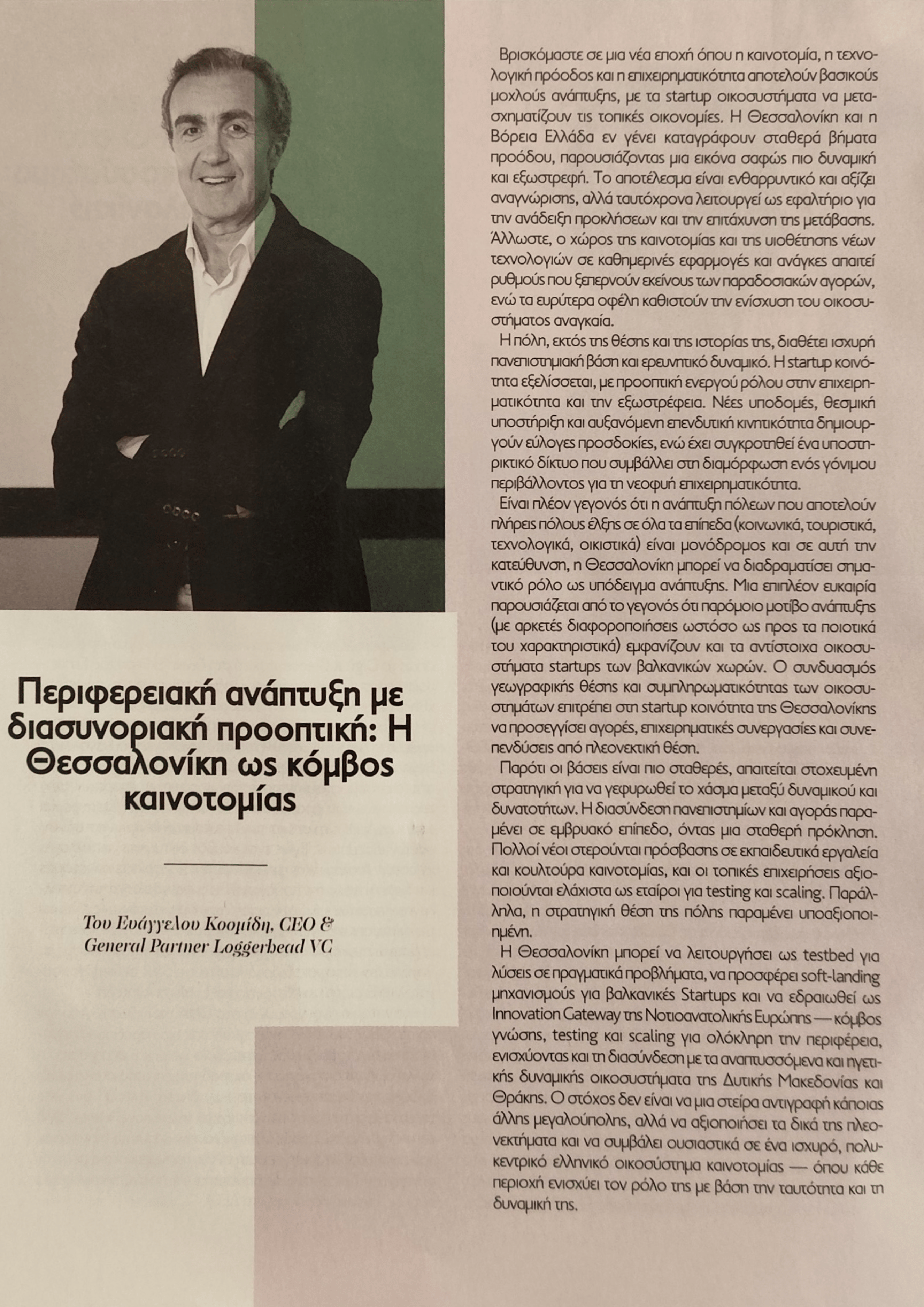
This article is an opinion piece by Dr. Evangelo Kosmidis, CEO of Loggerhead Ventures. It was originally published in Greek in the Startupper Magazine, circulated with the weekend edition of Parapolitika on August 23rd, 2025.
We are entering a new era where innovation, technological progress, and entrepreneurship are key drivers of development, with startup ecosystems transforming local economies. Thessaloniki — and Northern Greece more broadly — is making steady progress within the European innovation landscape, presenting a clearly more dynamic and outward-looking profile. The momentum is encouraging and deserves recognition, but it also serves as a springboard for addressing remaining challenges and accelerating the transition. After all, the innovation space — especially when it comes to adopting new technologies in everyday applications and needs — demands a pace that surpasses that of traditional markets. The broader benefits make strengthening the ecosystem not just beneficial, but essential.
Beyond its strategic location and historical importance, the city boasts a strong academic and research base. Its startup community is evolving, with growing potential to play an active role in entrepreneurship and market openness. New infrastructure, institutional support, and increasing investment activity create reasonable expectations, while a support network has emerged — one that contributes time, expertise, and commitment — helping shape a fertile environment for early-stage entrepreneurship.
Today, the development of cities that act as full-scale hubs across all dimensions — social, touristic, technological, and residential — is no longer optional. Thessaloniki is well-positioned to play a leading role in this direction as a model of regional development. An additional opportunity arises from the fact that a similar growth pattern — albeit with differing qualitative characteristics — can also be observed in the startup ecosystems of Balkan countries. The combination of geographical proximity and ecosystem complementarity allows Thessaloniki’s startup scene to access markets, form business collaborations, and pursue co-investments from a position of strength.
While the foundations are now more solid, a targeted strategy is required to bridge the gap between potential and realization. University–industry links remain underdeveloped and persist as a key challenge. Many young people lack access to innovation-oriented education and tools, while local businesses are rarely engaged as partners in testing or scaling solutions. At the same time, the city’s strategic location remains underutilized.
Thessaloniki has the potential to serve as a real-world testbed for solving pressing problems, to provide soft-landing mechanisms for Balkan startups, and to establish itself as the Innovation Gateway of Southeastern Europe — a hub of knowledge, testing, and scaling for the entire region. This includes strengthening its connections with the fast-growing, high-potential ecosystems of Western Macedonia and Thrace. The goal is not to replicate another major city, but to build on Thessaloniki’s unique strengths and contribute meaningfully to a strong, multi-nodal Greek innovation ecosystem — one where every region reinforces its role based on its identity and unique capacity for impact.