

Why we Invested in SolidWatts — the Startup Electrifying One of Industry’s Hardest-to-Decarbonize Sectors
With a breakthrough solid-state RF architecture, SolidWatts delivers clean, controllable heat that can replace fossil fuels across global manufacturing.
Industrial heat is one of the quiet forces behind modern life. It is the invisible engine behind the food we eat, the clothes we wear, the materials in our homes, and even the recycled plastics that re-enter the circular economy. Nearly every manufacturing process depends on it. Yet despite its importance, 75% of industrial heat in Europe still comes from fossil fuels, a legacy approach with enormous environmental cost.
For almost a century, factories have relied on gas because alternatives lacked the power, reliability, or precision to replace it. Industrial heat became one of the toughest sectors to decarbonize, a high-emission challenge hiding in plain sight. But a once-niche technology is now positioned to reshape this landscape: solid-state Radio Frequency (RF) dielectric heating, a method that generates heat directly inside of the materials using electromagnetic fields. It is the same physical principle behind a microwave oven, reinvented for industrial scale with vastly greater power and control.
This is where SolidWatts enters the story.
The Hidden Problem: A Billion-Dollar Sector Stuck in the Past
RF heating is exceptionally efficient – uniform, fast and clean – but historically it depended on vacuum-tube technology, the same analogue family that powered mid-century radios. These tubes came with major limitations: power typically capped below 250 kW, short lifetimes requiring constant replacements, dangerous high-voltage operation, limited precision, and a bulky form factor. As global supply chains for vacuum tubes shrank, so did their practicality.
Walk into many manufacturing plants today and you will still find 20th-century heating systems powering 21st-century production lines. The mismatch is visible everywhere: modern industrial processes running on legacy combustion hardware that was never designed for today’s efficiency, quality or sustainability demands.
As a result, RF heating remained stuck in niche applications, unable to scale into the core of industrial heat. The sector did not need a minor upgrade; it needed a leap.
The Breakthrough: Solid-State RF Power at Industrial Scale
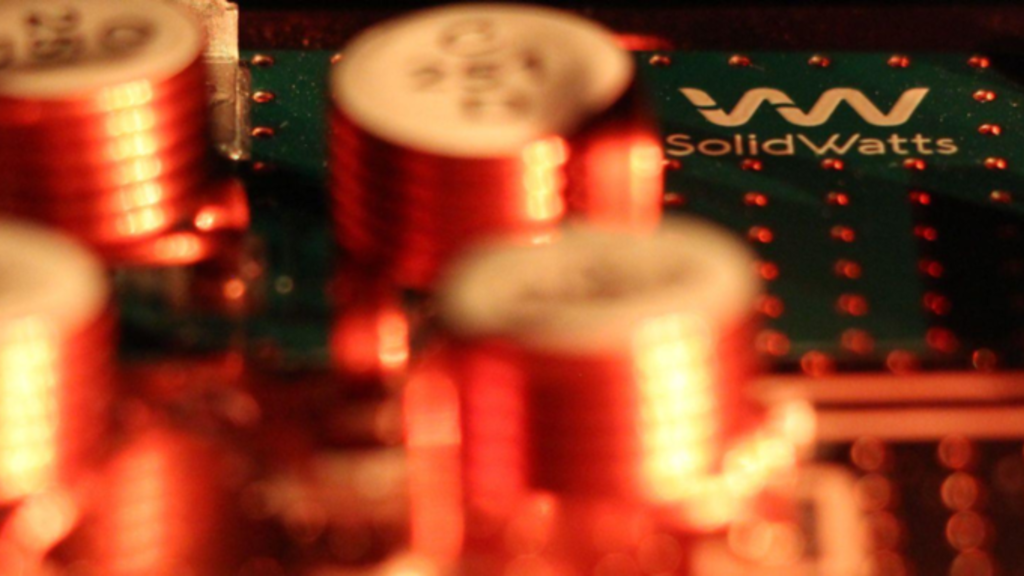
SolidWatts represents that leap. As one of the first companies to build high-power solid-state RF generators for industrial use, they replace vacuum tubes with modern power transistors and fundamentally change what’s possible. Power becomes scalable from 10 kW to multi-megawatt systems. Efficiency surpasses 85%, roughly double that of legacy tubes. Digital control delivers unprecedented precision over power, frequency, and phase. Safety improves as high-voltage tube circuits disappear, and service lifetimes exceeding 100,000 hours cut downtime dramatically.
All of this is delivered through a modular architecture: 10 kW solid-state modules slot into standard 19-inch racks, allowing manufacturers to expand capacity by adding units, build redundancy through fast swap-outs, or reach megawatt-level installations by combining stacks. It is the difference between the analogue rigidity of the past and the flexible, digital infrastructure of modern power electronics. Put simply, the SolidWatts system works like “energy LEGO”: factories can add or remove modules as needed, without rebuilding the entire installation.
With solid-state RF, industrial heat becomes a scalable, precise, electrified platform fit for the factories of the future.
As Dr. Markus Aicheler, CTO and Founder of SolidWatts, explains:
Natural gas has been the default for industrial process heating. It can do many things, but none of them really well. Gas burners, boilers and ovens inherently have many efficiency losses and require regular maintenance. Dielectric heating has always been a highly efficient form of heating, but in its analogue form, lacked the outright power needed for heavy industry and large scale process industries. Leveraging the latest solid-state power electronics, our unique design and software, SolidWatts unlocks dielectric heating for these industries, providing a modern, clean and highly efficient alternative. We are excited to bring transformation to industrial heating and enable the shift to electrification.
The Loggerhead Ventures Thesis
Replacing gas-fired heat is not only a technical challenge; it is one of the most consequential climate priorities of our time. Industrial heat accounts for a significant share of global emissions, and factories operate with tolerances so tight that any new system must outperform the one it seeks to replace. To gain adoption, a solution must be cleaner, more precise, more reliable and more economical — all at once.
Solid-state RF heating meets that bar in a way combustion never can. By heating materials directly instead of the surrounding equipment, RF reduces energy waste and lowers operating costs. Digital control improves throughput and product quality. Electrification eliminates fossil-fuel combustion at its source, enabling a single installation to avoid tens of thousands of tonnes of CO₂ over its lifetime. At higher power levels, solid-state RF also unlocks processes that were previously impractical, from advanced chemical reactions to plastics recycling and green metallurgy.
This is not an incremental improvement. It is a platform that fundamentally reshapes what factories can achieve and a powerful lever for deep, system-level decarbonization.
That is precisely why we invested. As a climate-tech venture fund, we focus on technologies that can deliver structural emissions reductions across essential industrial value chains. Industrial heat sits at the core of global manufacturing, and any credible path to Net Zero must electrify the processes that produce food, materials, chemicals, polymers, textiles and steel. SolidWatts’ architecture is the first technology with the power, precision and modular scalability to replace gas-based heating at industrial scale.
The market opportunity spans nearly every major industrial sector, and the company’s module-based solution is inherently global and defensible. The impact is immediate and measurable: lower energy use, reduced emissions, higher throughput, fewer defects and entirely new industrial capabilities enabled by digitally controlled, high-power RF heating.
As Dr. Evangelos Kosmidis, CEO and General Partner of Loggerhead Ventures, explains:
What impressed us about SolidWatts was the combination of world-class RF science and a clear understanding of how to decarbonize heavy industry in practice. The team knows that industrial operations demand uptime, safety and precision, and they have built a platform that delivers all of that while eliminating fossil-fuel combustion at its source. This is more than a hardware upgrade; it is a pathway to dramatically lower emissions across entire value chains. We believe their solid-state RF technology can become a cornerstone of the next generation of clean manufacturing.
The Road Ahead
Solid-state RF has the potential to become a foundational technology for industrial electrification, much like semiconductors transformed the digital world. By replacing gas-fired heat with clean, precisely controlled RF power, solutions like SolidWatts can accelerate decarbonization, enable new material and recycling pathways, and reshape how factories operate.
SolidWatts offers this different future: one where clean energy, digital precision and high-performance manufacturing reinforce each other instead of competing. The shift from combustion to solid-state RF is not a marginal upgrade. It is a fundamental rethinking of how heat, one of industry’s most essential inputs, is generated and controlled.