
Interview: From Idea to Market — What It Takes to Build Startups in Greece
What does it really take to turn an idea into a company?
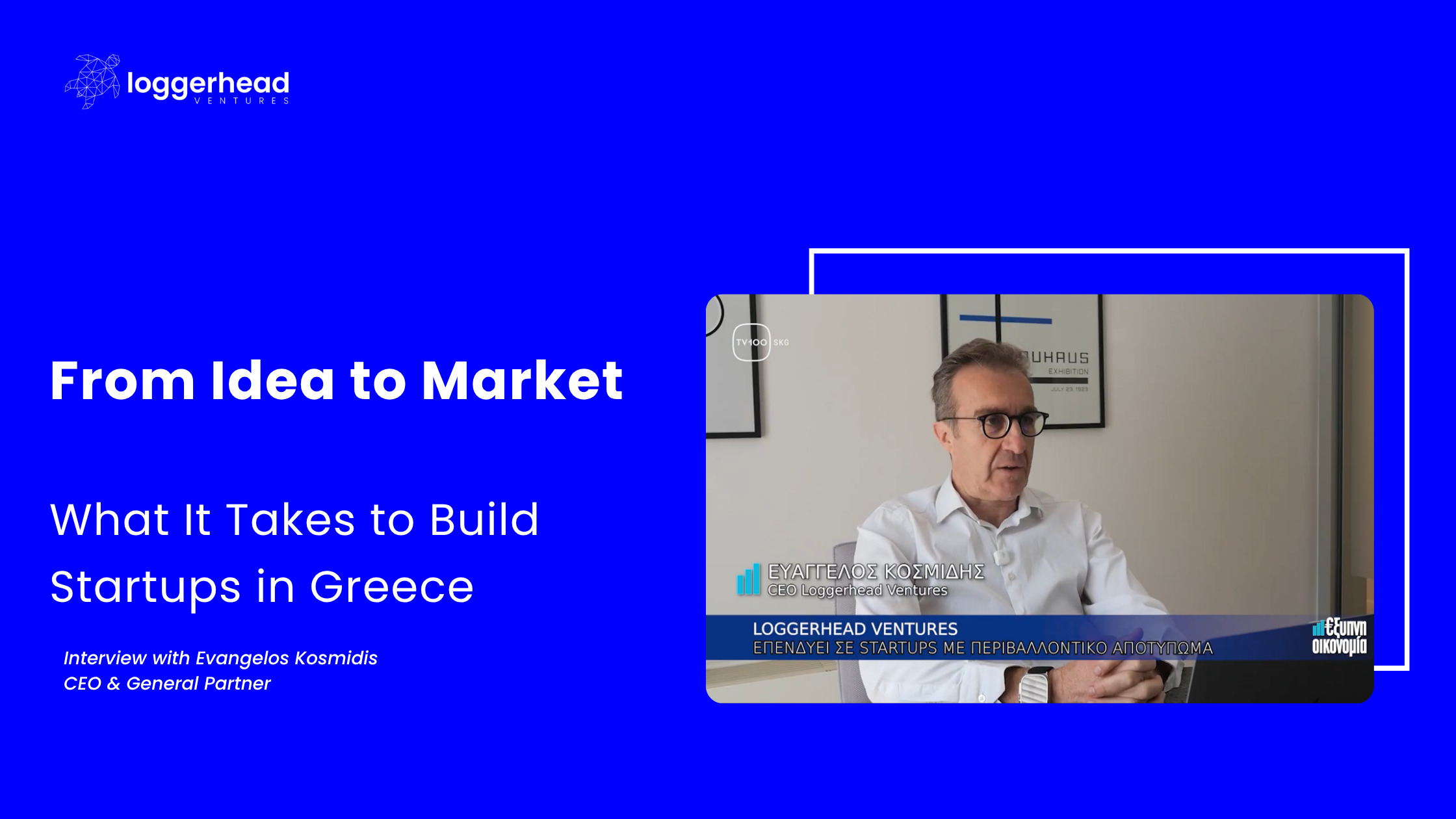
In a recent conversation with George Katsianis, Loggerhead Ventures CEO, Dr. Evangelos Kosmidis, reflects on this question through the lens of early stage investing and the realities of building startups in Greece today.
Loggerhead Ventures was launched in early 2024 with a clear focus: to invest in technologies that contribute to the environment while also proving that such solutions can be commercially viable. Managing a €10 million fund, the team set out not just to support innovation, but to test whether climate-driven technologies can translate into real economic value.
In just two years, the fund has reviewed more than 200 startups. Each one brought something compelling, often strong scientific foundations and ambitious ideas. Yet only a small number made it through.
The reason lies beyond the idea itself.
While financial metrics and business plans remain important, one element consistently stands out: the team. Not just its technical strength, but its ability to move beyond research and step into the market. To take a scientific concept and shape it into something that can be sold, adopted, and scaled.
This transition is where most startups struggle.
For years, lack of funding was considered the primary barrier. Today, according to Dr. Kosmidis, that is no longer the case. Capital exists, both from private and public sources. The real challenge lies elsewhere.
It is in the moment when a solution meets the market.
Startups must move beyond the logic of science and begin to understand demand, customers, and real-world application. Securing the first client, running a pilot, proving that someone is willing to adopt the solution. These are the steps that define whether a company can move forward.
The role of a venture capital fund, then, is not only to invest, but to guide this transition. From the first pitch, through technical validation, to financial and legal due diligence, the process is designed to identify not just promising ideas, but companies that are ready to operate in the real world.
This journey is also shaped by the environment in which startups grow.
Thessaloniki, as Dr. Kosmidis describes, offers a strong foundation. Universities, research centers, and a steady flow of talent create the conditions for innovation. More scientists are now considering entrepreneurship as a next step.
Yet the ecosystem remains incomplete. The number of companies able to adopt new technologies is still limited, often forcing startups to look beyond the local market to find their first customers.
Despite this, the direction is clear.
Loggerhead Ventures plans to invest in up to 15 to 20 companies, supporting them as they grow and preparing them for the next stage. Growth, for a venture-backed company, is not the end goal in itself. It is a step toward something bigger: adoption, scale, and ultimately, exit.
Because in the end, success is not defined by the idea alone.
It is defined by whether the market is ready to accept it.