
What Investors Really Look for in a Pitch Deck: Loggerhead Ventures at the ELKAK Reverse Pitching Session
September 8, 2026
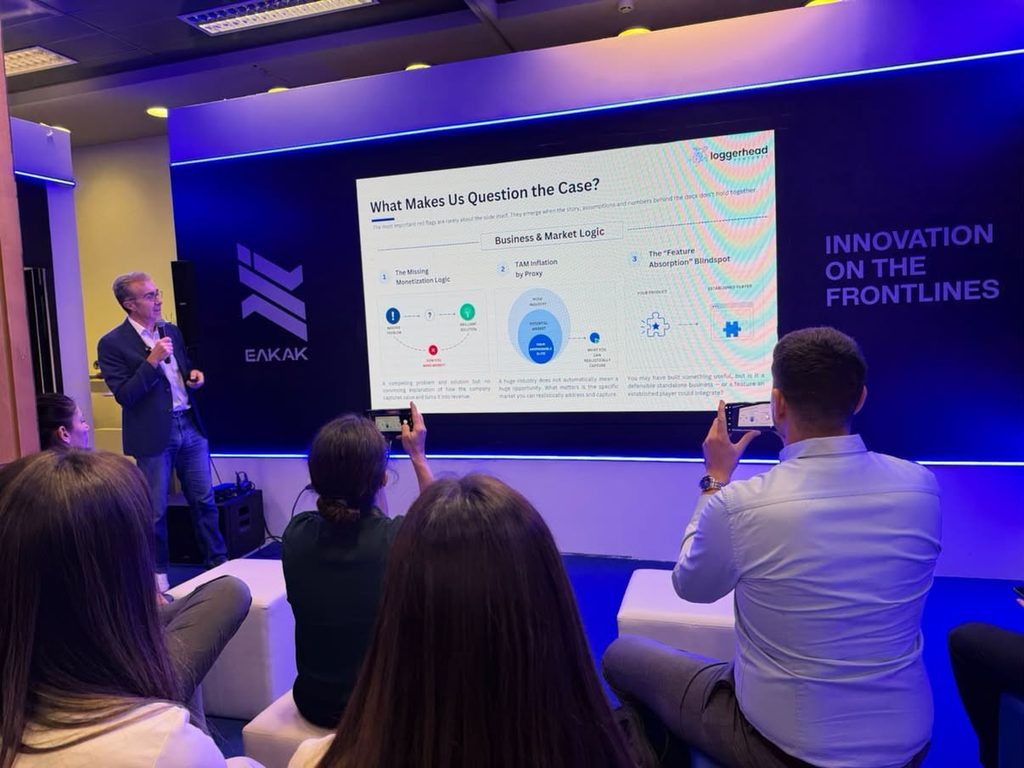
Loggerhead Ventures participated in the Reverse Pitching sessions organised by the Hellenic Centre for Defence Innovation (ELKAK) on 5 September 2026, as part of the 90th Thessaloniki International Fair. Dr Evangelos Kosmidis, CEO & General Partner of Loggerhead Ventures, reversed the usual pitching dynamic, giving founders an investor’s perspective on what makes an early-stage company investable, what investors are really evaluating when they look at a pitch deck, and what can make them start questioning an investment case.
Inside the Reverse Pitch: What Investors Actually Look For
Most founders know what a pitch deck is expected to contain: the problem, the solution, the market, traction, competition, business model, team and funding ask. If most decks contain these elements, however, where does an investment case begin to break down?
As Dr Kosmidis explained during the session, investors do not simply read what appears on each slide. They translate the information presented into questions about the underlying investment case.
When a founder presents the problem, the investor is asking whether it is painful and urgent enough that someone will actually pay to solve it. When the market is presented, the question becomes whether the opportunity can become large enough to generate venture-scale returns. And when the conversation reaches the funding ask, the focus is not simply on how much capital the company wants to raise, but on what that capital will allow the company to prove, achieve or de-risk.
The presence of the expected slides is therefore only the starting point. What matters is whether the assumptions and evidence behind them come together to form a coherent and credible investment case.
From Interest to Conviction
The first interaction with an investor does not need to answer every possible question. It does, however, need to create enough conviction to make the remaining questions worth investigating.
Clarity is one of the first tests. After hearing the pitch, an investor should be able to articulate what problem the company solves, how it solves it, who pays and why it matters.
Evidence is equally important, but it needs to be appropriate to the company’s stage. A pre-seed company is not expected to demonstrate seed-stage metrics. What matters is whether its claims are supported by the strongest evidence currently available and whether the founders can clearly distinguish between what they know, what they assume and what still needs to be validated.
Then comes consistency. Market size, pricing, go-to-market, traction, financial projections and the fundraising ask should reinforce the same investment story. Assumptions that appear reasonable individually can become far less convincing when considered together.
Ultimately, each step of the evaluation should increase an investor’s conviction or provide a compelling reason to investigate further. The funding round should also materially change the company’s risk profile by enabling meaningful milestones, rather than simply buying additional runway.
Why Investors Start Questioning the Case
The most important red flags are rarely about the slide itself. They tend to emerge when the story, assumptions and numbers behind the deck no longer hold together.
In terms of business and market logic, a compelling problem and an impressive technology are not enough if there is no convincing explanation of how the company will capture value and turn it into scalable revenue. Similarly, a very large industry does not necessarily translate into a very large addressable opportunity for a particular startup.
Questions also emerge around growth and economics. Ambitious customer projections mean little without a credible acquisition engine, while strong customer acquisition can hide poor retention or a high underlying cost of growth.
On risk and execution, investors look beyond the product itself to the barriers between the technology and the market. Regulation, certification, dependence on a critical supplier or partner, and assumptions about when product-market fit will be achieved can materially change the investment case.
Finally, investors examine the logic behind the funding round itself. Raising a round is not an objective in its own right. The more important question is what will be materially different about the company when that capital has been deployed. Runway explains how long the money lasts; milestones explain what the money achieves.
When the Team Becomes the Deciding Factor
Weaknesses in an investment case are not necessarily deal-breakers. Particularly at the early stage, many can be clarified, tested and strengthened. This is also where the team itself becomes part of the evaluation.
Early-stage companies inevitably operate with uncertainty. Investors therefore evaluate not only whether founders have all the answers, but also how they respond when their assumptions are challenged.
Openness to difficult questions, the self-awareness to distinguish evidence from assumptions, the ability to adapt when new information emerges and transparency about what has and has not yet been achieved can all influence whether an investor decides to continue the conversation.
An imperfect pitch deck can be improved. An assumption can be tested. A go-to-market strategy can evolve. But doing so requires a team willing to engage critically with the gaps in its own investment case.
As Dr Kosmidis concluded during the session:
“We can work through gaps in an investment case. It is much harder to work around a team that cannot adapt. A strong team can give us a reason to keep the conversation open, even when the company is not yet ready for investment.”